International Centre for Climate Change Research and Studies
Centre
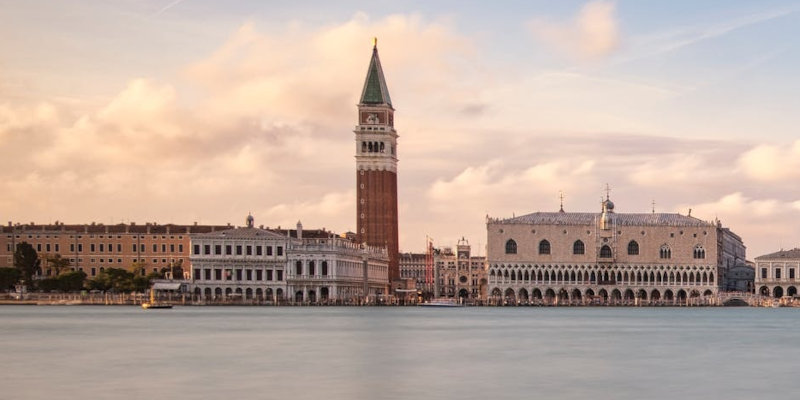
Located in the iconic city of Venice, the International Centre for Climate Change Research and Studies (CSRCC) is dedicated to addressing the challenges of climate change through cutting-edge research, international collaboration, and innovative solutions for coastal and urban resilience.
|
|
CSRCC statute [ITA] | 113 KB |
Mission and vision
Our mission is to advance the understanding of climate change impacts and develop strategies for mitigation, adaptation, and resilience, leveraging Venice as a global hub for knowledge sharing and innovation.
Current research projects
Venice and its lagoon require an integrated approach to address climate change, overcoming disciplinary and institutional fragmentation. Planning efforts are hindered by the dispersion of knowledge and the lack of a shared platform to make it accessible. The CSRCC aims to fill this gap by bridging research, policy, and society, and by making accessible the data and knowledge relevant to local decision-making. The CSRCC is activating two complementary lines of work:
- assessment report: a regional report on climate change impacts and adaptation strategies in the Venetian context, inspired by IPCC reports. The report production process will be transparent, transdisciplinary, and inclusive, aiming to translate scientific knowledge into concrete support to decision-making;
- meta-database: a publicly accessible online meta-database that collects and organizes data and research on climate change in the Venetian area, spanning multiple disciplines. It will provide the foundation for the Assessment Report and serve as a unified platform for accessing this information on the CSRCC website.
Discover more about the assessment report and metadatabase.
Transdisciplinary participatory approaches for climate change adaptation
The CSRCC is embarking on a journey to engage the Venetian community in a reflection on the future of the city and its lagoon in the context of climate change. A key milestone in this journey was the Climathon 2025, a global event promoted by ClimateKIC, which the CSRCC organized in Venice on 4-5 October 2025. This event provided an opportunity to stimulate active citizen participation and foster the co-creation of innovative solutions to enhance the territory’s resilience to extreme events. The Climathon marks the launch of a public engagement program structured around two parallel tracks: an innovation track, aimed at developing the ideas generated during the event into projects or start-ups, and an educational track, involving local schools. These initiatives will help build a relationship of trust between CSRCC and the local community, and promote dialogue between civil society and scientific research.
For further information see also the webpage Climathon Venice 2025 and the event InnovationLab.
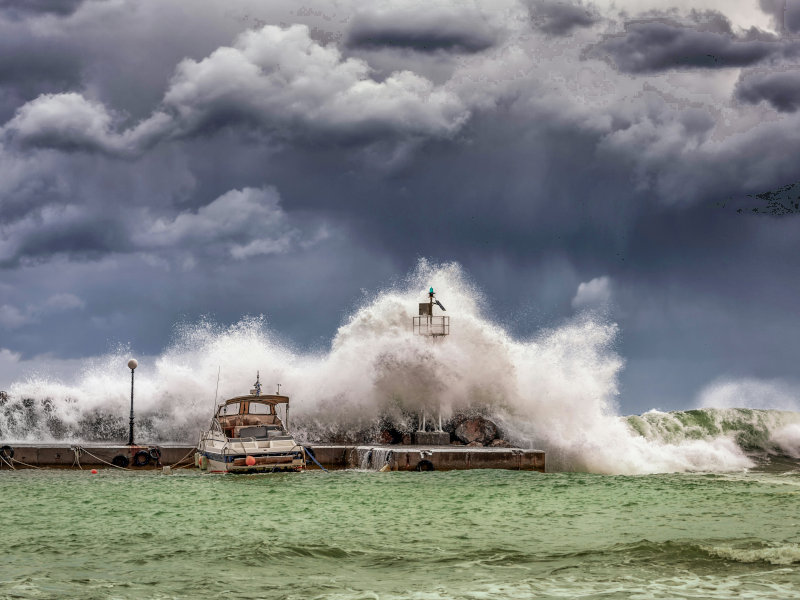
Sea level rise, subsidence, and the increasing frequency of extreme weather events represent major challenges for the sustainability of coastal areas. The Venetian Lagoon, influenced by both natural dynamics and significant human pressures for several centuries, is an ideal laboratory for studying past sea level changes and estimating future scenarios. This project aims to reconstruct the millennial evolution of sea level and any subsidence components through biostratigraphic analysis of a series of stratigraphic cores taken along a transect in saltmarsh environments. A key element will be the identification of a modern transect to serve as a reference for documenting the current distribution of sedimentary facies and foraminiferal assemblages in various tidal environments. The data obtained will be compared with those from the cores, in order to identify reliable proxies for reconstructing past sea levels and dating them accurately. The comparison with independent historical data – such as the position of algae belts and lithic water level markers observed in the city through iconographic and written sources – will allow geological evidence to be integrated with historical and observational records, improving chronological calibration and validating stratigraphic data. An additional development of the project will involve identifying deposits or erosive surfaces associated with flood events (storm surges) in the pre-industrial era (e.g., before 1850), which may contribute to understanding the frequency and intensity of extreme events in the recent past. Overall, the expected results will provide a solid scientific basis for estimating future sea level changes in the lagoon and support local-scale adaptation strategies, by integrating geological, biological, and historical approaches in an interdisciplinary perspective.
Promoting climate adaptation in spatial planning tools. Towards adaptive planning in the Venetian context
Spatial and urban planning plays a key role in promoting the implementation of climate adaptation measures and actions to make cities and territories more resilient to the risks associated with climate change and the impacts of extreme events.
Within the Italian hierarchical planning framework, climate adaptation becomes increasingly operational and transformative while getting from the national to the local administrative scales, with the super-ordinate bodies (e.g. state, regions) generally providing guidance and strategic directions for the local authorities (municipalities, metropolitan cities), which are responsible to regulate many of the transformations that influence the responsiveness of territories and cities to climate pressures (e.g. land use changes, design of public spaces, development of local infrastructures, etc.). In parallel, there are several territorial bodies (e.g., land reclamation consortia, river basin authorities, etc.) whose competences include planning and programming activities for the management of certain climate-related risks in specific sectors (e.g., river flood risk management, management of minor hydrographic networks, drainage canals, and water resources for agriculture, etc.). Each of these bodies implements its plans, programmes, and policies. In addition, local authorities and stakeholders can create partnerships that lead to the drafting of planning and policy documents that often address climate adaptation aspects (e.g., river contracts). It is therefore evident that there are multiple possibilities for integrating and promoting climate adaptation actions and measures within the spatial and urban planning field, according to the specificity of the scale and/or type of plan/policy. In parallel, the European Union is increasingly pushing in the direction of an ecological and energy transition to (also) support climate change mitigation and adaptation, especially supporting actions and measures that deploy nature and ecosystem services (the so-called nature-based solutions) to adapt and enhance the resilience of cities and territories through a series of strategies, policies, and laws (e.g. EU green deal, EU adaptation strategy, EU biodiversity strategy, EU nature restoration law, etc.).
Within this contextual framework, this research aims to explore the different potentials and opportunities for integrating and promoting adaptation actions and measures, especially nature-based solutions, within and through spatial planning instruments and policies, with a particular attention to those relevant for the local scale. This will be done through both the consultation of appropriate literature and the collection of information on real-life examples, experiences, and good practices in this field, with a focus on Venice and its metropolitan area, but also considering national and international cases that might offer useful insights for the Venetian context. The results of the research will contribute to providing recommendations to local decision-makers operating within the urban and spatial planning field for promoting a greater integration and more systematic implementation of climate adaptation measures and actions, with particular reference to nature-based solutions, within local urban/spatial plans and policies.
Research collaborations
CSRCC works in partnership with global institutions, including research networks and policy advisory bodies, to amplify the impact of climate research.
Events
Upcoming events
November 2025-April 2026 - InnovationLab
InnovationLab is an innovation pathway designed to support the development of ideas that emerged during Climathon Venice 2025 and guide their evolution and implementation. The InnovationLab consists of a series of workshops dedicated to citizens, students, and third-sector associations, developed in collaboration with Foundation The Human Safety Net of Generali and GreenerEU. Here is the programme:
- Saturday, 8 November 2025, 11.00-13.00 – From idea to action: activating creativity and resilience (for Climathon participants, this meeting will be dedicated to integrating and refining the ideas that have emerged)
- Saturday, 13 December 2025, 11.00-13.00 – Cultural entrepreneurship: a driver of inclusion and sustainable change
- Saturday, 10 January 2026, 11.00-13.00 – Stakeholder mapping: collaboration and community networks
- Saturday, 7 February 2026, 11.00-13.00 – Measuring impact: responsibility, transparency, and real change
- Saturday, 7 March 2026, 11.00-13.00 – European funding: sustainability and growth strategies
- April 2026 (date to be defined) – Coaching and prototyping to refine the projects
The workshops will be held at The Human Safety Net House, Procuratie Vecchie, Piazza San Marco. Entrance from Corte Maruzzi, Piazza San Marco 105, Venice.
Building on the success of the 2025 edition, the CSRCC is preparing to establish the International Summer School as a prestigious annual event.
Stay tuned for upcoming announcements and opportunities to participate.
Past events
4-5/10/2025 - Climathon Venice 2025
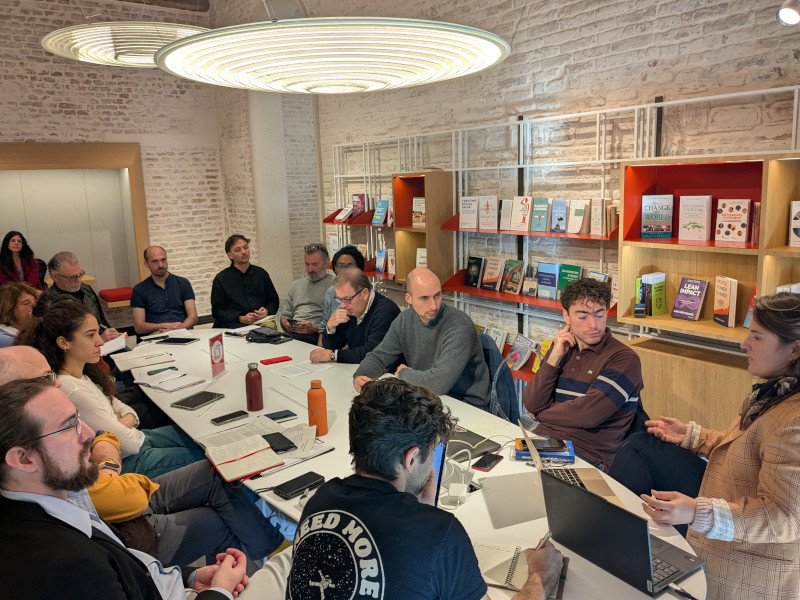
Climathon is an international event, coordinated by Climate-KIC, focused on active citizen engagement to tackle the challenges posed by climate change. The CSRCC organized the Climathon Venice 2025, held on 4–5 October 2025 at the Procuratie Vecchie in Piazza San Marco, Venice. The event actively involved around thirty participants – citizens, students, professionals and representatives of local associations – who took part in the workshops, while another fifty people attended the event’s final day as spectators. The Climathon focused on finding “bottom-up” solutions for the climate adaptation of Venice and its lagoon, with two strands closely tied to the city’s identity: on one hand, the search for ideas to support the most vulnerable people, paying special attention to the characteristics of the historic centre; on the other hand, the development of proposals capable of actively protecting and enhancing the lagoon ecosystem, leveraging biodiversity and traditional knowledge as a resource for the future. Participants, divided into six groups, imagined proposals ranging from the creation of a renewable energy community, to the construction of vertical gardens to reduce the urban heat island effect, to the creation of networks for collaboration between small businesses and associations to develop joint projects inspired by the values of sustainability, environmental justice and participation. The Climathon marks the start of a public engagement programme that is organised into two parallel tracks: InnovationLab, an innovation track designed to develop the ideas that emerged during the event into projects or start-ups, and an educational track with local schools.
12-17/06/2025 - International Summer School “Climate Change in Coastal Areas: Knowledge, Resilience, Adaptation”
The CSRCC has organized its first summer school dedicated to climate change in coastal areas, aimed at students, researchers, and professionals, in collaboration with Ca’ Foscari University of Venice, IUAV University, and the Veneto Institute of Sciences, Letters, and Arts.
The summer school took place at the Sala dell’Adunanza in Palazzo Loredan, located in the historic centre of Venice, San Marco 2945. The school is part of the initiative “Living on the Water. Towards 2100 - Sea Level Science in Venice”, a broad-reaching international event that brings together the CSRCC summer school, the final conference of the ERC project WARMCOASTS, and a workshop of the PALSEA and ONSEA working groups. The synergy between these three events has made Venice a focal point for advancing climate change research.
The summer school featured a rich educational programme covering various topics related to climate change in coastal areas, including the dynamic interactions that shape the evolution of coastal zones, alongside with adaptation, resilience and urban planning. The programme included 21 distinguished speakers from prestigious national and foreign universities and research centres, including Columbia University, Harvard University (USA), and City University of Hong Kong (HK).
The event has attracted approximately 40 international participants, which include PhD students and young researchers studying climate change from diverse disciplinary perspectives. Overall, the summer school has been a high-level scientific event, fostering knowledge exchange and the creation of professional networks.
|
|
Full programme 12-17/06/2025 | 481 KB |
3-8/06/2025 - Venice Climate Week 2025
The CSRCC has been a Legacy Partner of the Venice Climate Week 2025, an international event organized in Venice from June 3 to June 8, 2025. The event, curated by journalist Riccardo Luna with the support of the Future Food Institute, is designed as a platform for international leadership and systemic change, where science, governance, and innovation converge. In particular, the CSRCC contributed to the opening day on June 3 at the Procuratie Vecchie in Piazza San Marco and to the day dedicated to water on June 4 at Ocean Space, with two speeches by its President, prof. Carlo Barbante.
7/03/2025 - Presentation event for the book Le grandi ipocrisie sul clima
The CSRCC, in collaboration with Ca’ Foscari University and CaFoscariAlumni, organized the presentation event for the book “Le grandi ipocrisie sul clima” ["The Great Hypocrisies on Climate"] by Roger Abravanel and Luca D’Agnese. The event, held on March 7, 2025, at the ‘Emanuele Severino’ Auditorium of Ca’ Foscari University, featured a presentation of the book by the authors, followed by a roundtable discussion focused on the path to achieving global climate coherence. The roundtable, moderated by the President of the Center, included distinguished figures such as Daniele Franco, former Minister of Economy and Finance in the Draghi government; Katia Da Ros, CEO of Irinox SpA and former Vice President for Environment, Sustainability, and Culture at Confindustria Nazionale; Professor Carlo Carraro and Professor Monica Billio, internationally renowned faculty members of Ca’ Foscari University.
Team
Our team
Prof. Carlo Barbante
President
carlo.barbante@csrcc.it
Carlo Barbante has been the founder and director of the Institute of Polar Sciences of the National Research Council (CNR) and is a Full Professor at Ca’ Foscari University of Venice, where he focuses on climate and environmental reconstructions through the analysis of ice cores. He has taken part in numerous expeditions and sampling campaigns in polar regions and the Alps, and is the author of over 330 publications in high-impact scientific journals. He received a prestigious Advanced Grant from the European Research Council for the study of anthropogenic impact on climate in the pre-industrial era. From 2012 to 2014, he served as a visiting professor at the Accademia Nazionale dei Lincei and is an elected member and vice president of the Accademia Nazionale delle Scienze detta dei XL, as well as Secretary of the Science Class of the Istituto Veneto di Scienze, Lettere e Arti. Since 2025, he has been an elected member of the Accademia Nazionale dei Lincei. He is currently president of the International Center for Research and Studies on Climate Change. Recently, he was awarded the 2024 Minister of Culture Prize by the Accademia dei Lincei and the Canneri Medal by the Italian Chemical Society. As a science communicator, he recently published a book titled “Scritto nel ghiaccio”, which was a finalist for the "Mario Rigoni Stern" literary prize.
Prof. Francesco Musco
Vice-president
francesco.musco@csrcc.it
Francesco Musco is Full Professor of Urban Planning and Director of Research at Iuav University of Venice, president of Corila, and vice-president of the International Center for Study and Research on Climate Change (CSRCC). He has taught and conducted research both in Italy and abroad at institutions including the University of Louisville, Kentucky (Center for Environmental Policy and Management), Drexel University in Philadelphia, the University of Parma (Faculty of Economics), the University of Bologna (Faculty of Engineering), the University of Reading (Department of Real Estate and Planning), the Autonomous University of Barcelona (Geography), the University of Sassari in Alghero (Architecture), and the University of Seville. A strong advocate of a multidisciplinary approach to urban and territorial planning, in recent years he has focused his research on the relationships between urban planning, sustainability, and resilience, with particular attention to sustainable urban regeneration and the role of local plans in contributing to “climate-proof” planning. He serves as a consultant to numerous public and private institutions in Italy and abroad on urban planning, environmental and territorial policy, and local development.
Eng. Pierpaolo Campostrini
Administrative manager
campostrini@corila.it
Dr. Francesca Tonin
Administrative secretary
amministrazione@csrcc.it
Dr. Silvia Rova
Programme manager
silvia.rova@csrcc.it
Silvia Rova is the Programme Manager at the International Centre for Climate Change Research and Study (CSRCC). She holds a degree in Marine Biology from the University of Padua and a degree in Ecohydrology from the Christian-Albrechts University of Kiel, Germany. She earned her PhD in Science and Management of Climate Change at Ca' Foscari University of Venice, where she worked as a researcher in ecology and currently teaches as an adjunct professor. Her research is characterized by a strongly interdisciplinary approach, both in the scope and in the methods employed. She has explored, on one hand, how our well-being depends on nature through a variety of social–ecological interactions, and on the other, how these interactions, often taken for granted, can be affected by climate change and management decisions. The magnitude of these challenges led her to embrace a more active role in driving meaningful change in society. That’s why she now places her experience and deep knowledge of the Venice Lagoon at the service of CSRCC’s mission. Because balancing our relationship with nature is a necessary condition for a sustainable future.
Dr. Nicolò Ardenghi
Researcher
nicolo.ardenghi@csrcc.it
Nicolò Ardenghi is a researcher at the International Center for Climate Change Studies and Research (CSRCC). He focuses on synthesizing and organizing research and data on climate change mitigation, resilience, and adaptation in the Venetian area and on translating scientific findings into practical recommendations for policymakers. With a background in Natural and Environmental Sciences, he has worked on paleoclimate research projects reconstructing past environmental and climatic changes, developing a strong interest in the links between climate, environment, and society. He views Venice and its lagoon as an exemplary setting for addressing the challenges of climate adaptation and mitigation.
Dr. Ciro Cerrone
Researcher
ciro.cerrone@csrcc.it
Ciro Cerrone is a coastal geomorphologist specializing in Quaternary sea-level reconstruction. His research focuses on the identification, analysis, and dating of past sea-level indicators preserved along both active and passive continental margins. His study areas include coastal regions of the Mediterranean Sea, the Caribbean, and the Atlantic Ocean, where he investigates the interplay between tectonics, sedimentary processes, and relative sea-level change to better understand coastal evolution through time. He obtained a Ph.D. in Earth, Environmental and Resources Science from the University of Naples Federico II in 2021, graduating with the highest distinction ("Eccellente"). During his academic training, he acquired international experience through study and research activities at several institutions, including the University of Cuyo (Mendoza, Argentina), the Universities of Salamanca and Granada (Spain), the Agricultural University of Athens (Greece), Birkbeck, University of London (UK), and MARUM – Center for Marine Environmental Sciences at the University of Bremen (Germany).
Dr. Davide Longato
Researcher
davide.longato@csrcc.it
Davide Longato. Urban and environmental planner, I am a postdoctoral researcher in Urban and Regional Planning. I work at the intersection of science and policy, focusing on sustainable urban development and climate change adaptation. I specialize in planning instruments and land policies for ecological transition and climate adaptation, environmental assessments, and nature-based solutions for urban and territorial resilience. I received my MSc in “Planning and Policies for Cities, Environment and Landscape” from the University IUAV of Venice, and I hold a PhD from the University of Trento (IT). I have experience as planning consultant for regional and local administrations.
Dr. Shannon Valley
Researcher
shannon.valley@csrcc.it
Shannon Valley is a transdisciplinary strategist motivated by her concern for the impacts of climate change on vulnerable populations and ecosystems. Her Ph.D. and postdoctoral research focused on ocean circulation’s relation to abrupt climate change and carbon storage and emissions in coastal wetlands. While at the United States Agency for International Development, Shannon served as a mitigation specialist supporting efforts to reduce emissions, strengthen resilience, and promote just, climate-positive development with partnering governments and community organizations in countries around the world. Prior to her climate work, Shannon served as a legislative liaison at NASA and as an assistant to the White House Domestic Policy Council.
Scientific and Technical Committee
- Prof. Filippo Giorgi
- Prof. Igor Linkov
- Prof. Piero Lionello
- Prof. Marco Marani
- Prof. Franco Montalto
- Prof. Maraja Riechers
- Dr. Barbara Neumann
Partner with us
Our strength lies in collaboration with leading research institutions and public bodies. Together, we drive impactful solutions for the world’s most pressing climate challenges.
Interested in partnering with us? Reach out at info@csrcc.it.
Join CSRCC team
Explore career opportunities with CSRCC, including scientific and administrative roles.
Volunteer with us in outreach programmes or contribute to public awareness campaigns on climate resilience.
For further information: info@csrcc.it.