Research


CSRCC at the interface between science, policy and society
Assessment report and meta-database
Venice and its lagoon require an integrated approach to address climate change, overcoming disciplinary and institutional fragmentation. Planning efforts are hindered by the dispersion of knowledge and the lack of a shared platform to make it accessible. The CSRCC aims to fill this gap by bridging research, policy, and society, and by making accessible the data and knowledge relevant to local decision- making. The CSRCC is activating two complementary lines of work:
Venice climate assessment report: a regional report on climate change impacts and adaptation strategies in the Venetian context, inspired by IPCC reports. The report production process will be transparent, transdisciplinary, and inclusive, aiming to translate scientific knowledge into concrete support to decision-making.
Meta-database: a publicly accessible online meta-database that collects and organizes data and research on climate change in the Venetian area, spanning multiple disciplines. It will provide the foundation for the Assessment Report and serve as a unified platform for accessing this information on the CSRCC website.
Transdisciplinary participatory approaches for climate change adaptation
The CSRCC is embarking on a journey to engage the Venetian community in a reflection on the future of the city and its lagoon in the context of climate change. A key milestone in this journey was the Climathon 2025, a global event promoted by ClimateKIC, which the CSRCC organized in Venice on 4-5 October 2025. This event provided an opportunity to stimulate active citizen participation and foster the co- creation of innovative solutions to enhance the territory’s resilience to extreme events. The Climathon marks the launch of a public engagement program structured around two parallel tracks: an innovation track, aimed at developing the ideas generated during the event into projects or start-ups, and an educational track, involving local schools. These initiatives will help build a relationship of trust between CSRCC and the local community, and promote dialogue between civil society and scientific research.
For further information see also the webpage Climathon Venice 2025 and the event InnovationLab.
Past sea level changes in the Venetian area
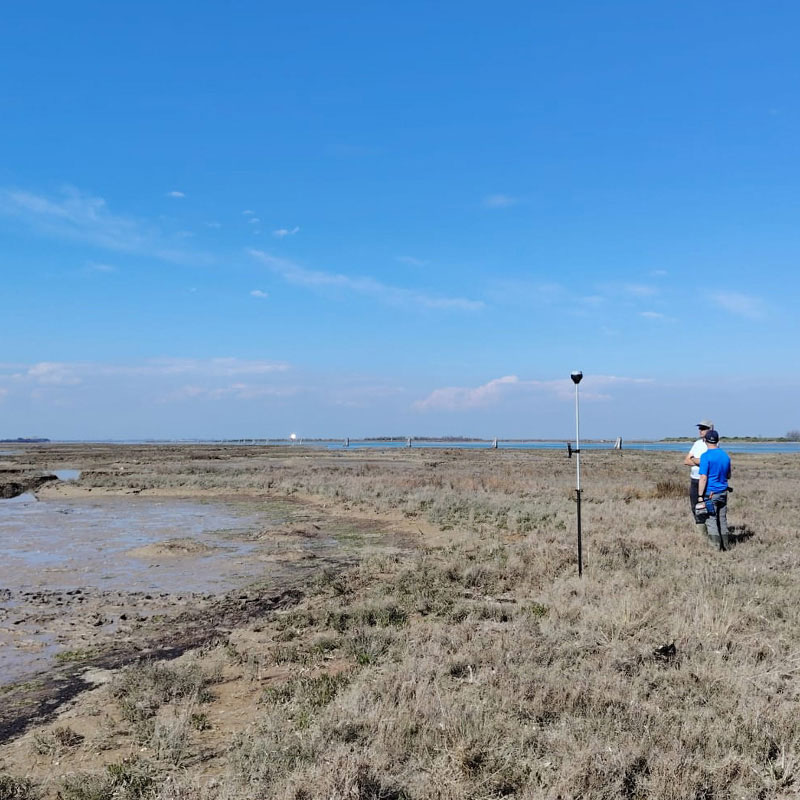
Sea level rise, subsidence, and the increasing frequency of extreme weather events represent major challenges for the sustainability of coastal areas. The Venetian Lagoon, influenced by both natural dynamics and significant human pressures for several centuries, is an ideal laboratory for studying past sea level changes and estimating future scenarios. This project aims to reconstruct the millennial evolution of sea level and any subsidence components through biostratigraphic analysis of a series of stratigraphic cores taken along a transect in saltmarsh environments. A key element will be the identification of a modern transect to serve as a reference for documenting the current distribution of sedimentary facies and foraminiferal assemblages in various tidal environments. The data obtained will be compared with those from the cores, in order to identify reliable proxies for reconstructing past sea levels and dating them accurately. The comparison with independent historical data – such as the position of algae belts and lithic water level markers observed in the city through iconographic and written sources – will allow geological evidence to be integrated with historical and observational records, improving chronological calibration and validating stratigraphic data. An additional development of the project will involve identifying deposits or erosive surfaces associated with flood events (storm surges) in the pre-industrial era (e.g., before 1850), which may contribute to understanding the frequency and intensity of extreme events in the recent past. Overall, the expected results will provide a solid scientific basis for estimating future sea level changes in the lagoon and support local-scale adaptation strategies, by integrating geological, biological, and historical approaches in an interdisciplinary perspective.
Promoting climate adaptation in spatial planning tools. Towards adaptive planning in the Venetian context
Spatial and urban planning plays a key role in promoting the implementation of climate adaptation measures and actions to make cities and territories more resilient to the risks associated with climate change and the impacts of extreme events.
Within the Italian hierarchical planning framework, climate adaptation becomes increasingly operational and transformative while getting from the national to the local administrative scales, with the super-ordinate bodies (e.g. state, regions) generally providing guidance and strategic directions for the local authorities (municipalities, metropolitan cities), which are responsible to regulate many of the transformations that influence the responsiveness of territories and cities to climate pressures (e.g. land use changes, design of public spaces, development of local infrastructures, etc.). In parallel, there are several territorial bodies (e.g., land reclamation consortia, river basin authorities, etc.) whose competences include planning and programming activities for the management of certain climate-related risks in specific sectors (e.g., river flood risk management, management of minor hydrographic networks, drainage canals, and water resources for agriculture, etc.).
Each of these bodies implements its plans, programmes, and policies. In addition, local authorities and stakeholders can create partnerships that lead to the drafting of planning and policy documents that often address climate adaptation aspects (e.g., river contracts). It is therefore evident that there are multiple possibilities for integrating and promoting climate adaptation actions and measures within the spatial and urban planning field, according to the specificity of the scale and/or type of plan/policy. In parallel, the European Union is increasingly pushing in the direction of an ecological and energy transition to (also) support climate change mitigation and adaptation, especially supporting actions and measures that deploy nature and ecosystem services (the so-called nature-based solutions) to adapt and enhance the resilience of cities and territories through a series of strategies, policies, and laws (e.g. EU green deal, EU adaptation strategy, EU biodiversity strategy, EU nature restoration law, etc.).
Within this contextual framework, this research aims to explore the different potentials and opportunities for integrating and promoting adaptation actions and measures, especially nature-based solutions, within and through spatial planning instruments and policies, with a particular attention to those relevant for the local scale. This will be done through both the consultation of appropriate literature and the collection of information on real-life examples, experiences, and good practices in this field, with a focus on Venice and its metropolitan area, but also considering national and international cases that might offer useful insights for the Venetian context. The results of the research will contribute to providing recommendations to local decision-makers operating within the urban and spatial planning field for promoting a greater integration and more systematic implementation of climate adaptation measures and actions, with particular reference to nature-based solutions, within local urban/spatial plans and policies.